
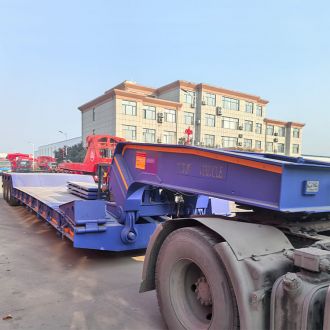
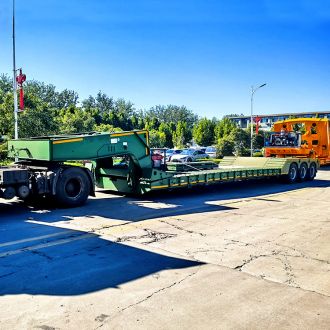
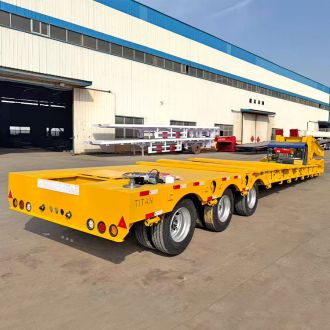
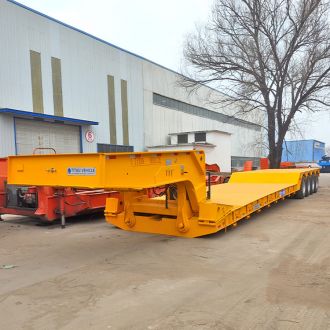
A detachable gooseneck lowboy trailer is built around a very specific transport problem: moving tall and heavy equipment while keeping the loaded height as low as practical. Unlike a conventional trailer that requires equipment to be lifted onto the deck, a detachable gooseneck configuration can separate at the front and create a low loading path for wheeled or tracked machinery. Once the equipment is positioned, the gooseneck is reattached and the unit becomes a road-going heavy-haul trailer.
That loading concept is what makes a gooseneck lowboy trailer different from a standard flatbed or ordinary lowbed. The low deck is not simply a dimensional feature. It is part of a larger arrangement intended to make construction, mining, quarry, earthmoving, and other heavy equipment easier to transport. This article looks at the role of detachable gooseneck equipment, why the low loading height matters, how RGN trailers fit different types of heavy equipment work, and which technical differences deserve attention when evaluating a configuration for use in Ghana.
The main reason for using a detachable gooseneck lowboy is straightforward: some machines are difficult to transport efficiently when the trailer deck is too high.
Heavy construction and earthmoving equipment can be tall even before it is placed on a trailer. Once the machine is loaded, the height of the machine and trailer are combined. A higher deck can therefore make the total transport package more restrictive.
A lowboy changes that relationship by bringing the equipment closer to the road surface. The detachable gooseneck adds another important feature: it allows the front connection to be separated so that the machine can be loaded from the ground rather than requiring a separate lifting operation.
A flatbed trailer is valuable when general cargo needs a relatively open platform. A conventional lowbed can provide a lower deck for heavy equipment. A detachable gooseneck lowboy goes further by changing the way the machine reaches the deck in the first place.
A tracked excavator, wheel loader, bulldozer, grader, or similar machine can potentially be driven onto a detached front loading area and then positioned directly on the main deck. The trailer is consequently part of the loading method, not just the transport platform.
The trailer arrives at the loading location. The gooseneck is detached. The machine approaches the low loading area using its own tracks or wheels. Once the equipment is positioned correctly, the connection is restored and the trailer is ready for transport.
1.1 Low deck height is about the entire transport profile
The low deck is often discussed as though it were an isolated specification, but its practical importance comes from what happens above it.
Suppose a piece of equipment is already tall by design. Adding a conventional trailer deck underneath it increases the overall transport height. Lowering the deck leaves more vertical space between the machine and the road environment.
That matters because heavy equipment transport is not only about weight. Height can influence the practical route, available clearance, and the way the load needs to be positioned on the trailer.
For a buyer, this means a lowboy should not be judged simply by asking how low the deck is. The more useful question is what kind of machinery the complete configuration is intended to carry and how that machinery sits on the deck.
A lower platform can be particularly meaningful when the transported machine has a high operating position, elevated cab, boom, counterweight, or other components that contribute to overall transport height.
1.2 Detachment changes loading, not just transportation
The gooseneck is what makes an RGN fundamentally different from a fixed-neck trailer.
With a fixed front connection, a machine generally has to reach the trailer deck from the rear or be lifted into position. A detachable gooseneck creates another loading path by separating the front section from the main trailer.
That is particularly useful for self-propelled heavy equipment.
The machine is not treated like a static cargo item that must be placed onto a platform by external lifting equipment. Instead, the trailer can be configured so the machine drives or tracks onto the loading area.
This distinction becomes important when heavy machinery is moved between jobsites rather than between fixed industrial facilities.
The equipment may already be on the ground at a construction site, quarry, mining support area, or equipment yard. In such situations, the ability to load directly from ground level is part of the reason to use an RGN configuration.
1.3 An RGN is a transport system, not simply a low trailer
The expression “lowboy trailer” can describe a broad family of heavy equipment trailers. An RGN is more specific because the detachable gooseneck affects the loading process as well as the trailer connection.
A conventional lowbed and a detachable gooseneck lowboy may both be used to move heavy machinery, but they can support different loading workflows. One may require the equipment to be winched, lifted, or loaded from the rear, while the RGN configuration can allow machinery to approach the deck from the front after the gooseneck has been detached.
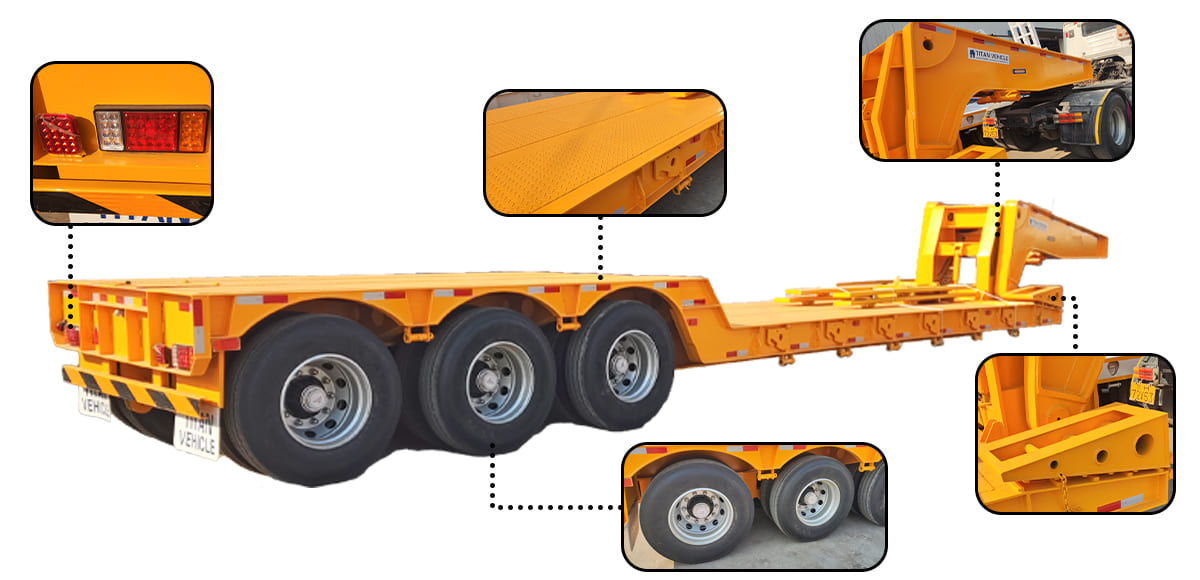 RGN Trailers | Detachable Gooseneck Lowboy Trailer for Sale in Ghana
The strongest application for RGN equipment is machinery that can reach the trailer under its own power and where low transport height is important.
This includes many categories of construction and earthmoving equipment, although the exact suitability still depends on the individual machine and trailer configuration.
For a fleet operating in Ghana, this makes the RGN concept relevant to transport tasks associated with jobsites rather than only fixed cargo terminals. A trailer may be moving equipment from an equipment yard to a project site, between different construction locations, or between work areas where the machinery itself is the cargo.
The equipment is not simply being delivered once. In many heavy-haul operations, the same machine may need to be repositioned repeatedly during its working life.
A detachable gooseneck lowboy trailer used for general cargo can focus heavily on load platform utilization. A trailer used for heavy equipment needs to work as part of a machine relocation process.
2.1 Excavators and tracked machines
Excavators are a natural example of where the RGN loading concept makes sense.
A tracked excavator can generally approach the trailer under its own movement rather than needing to be lifted like conventional cargo. The detachable front section creates a loading path that is closely connected with how the machine already moves.
The low deck also matters because excavators can have substantial overall height depending on their configuration. Keeping the machine closer to the road surface can help maintain a lower overall transport profile.
The important point is not that every excavator requires an RGN. It is that the equipment's own mobility makes the detachable gooseneck concept particularly relevant. The same logic can apply to other tracked machinery. Where a machine can be driven or tracked into position, a trailer that accommodates that loading method can fit more naturally into the transport workflow.
2.2 Bulldozers and graders
Bulldozers and graders present another practical application. These machines are designed to work on jobsites, which means they are already mobile within the environments where they are used.
When they need to move over longer road distances, however, transporting them on a dedicated heavy equipment trailer becomes more practical than relying on their own travel capability.
An RGN trailer provides a way to transition the machine from working equipment to transport cargo. The machine approaches the loading area, moves onto the trailer, is positioned on the deck, and then becomes secured cargo for road transportation.
For this type of equipment, the loading method can be as important as the trailer's general load rating. A trailer that technically supports the machine but does not offer an efficient loading arrangement may not fit the actual operation as well as an RGN.
2.3 Wheel loaders and self-propelled equipment
Wheel loaders and similar wheeled machinery can also align naturally with detachable gooseneck loading because they can approach the trailer under their own power.
The machine's length, width, height, wheel arrangement, and weight all interact with the trailer deck. The exact suitability cannot be established from the generic term “wheel loader” alone because different machines have different transport dimensions and configurations.
This is one reason why a heavy-haul trailer should be selected around the actual equipment fleet rather than around a general equipment category. The RGN design provides the loading concept. The specific trailer configuration determines how effectively that concept matches the machine.
2.4 Construction equipment moving between sites
A construction contractor may use the same machine across several projects. The transport requirement therefore appears whenever the machine needs to be repositioned. In that situation, the gooseneck lowboy trailer becomes an operational tool rather than a one-time delivery platform.
An RGN can fit this model because the loading process is designed around self-propelled machinery. The machine can move from the jobsite into the transport position without requiring the same type of fixed loading infrastructure that would be needed for certain static cargoes.
This application logic is especially useful when thinking about the role of a gooseneck lowboy trailer in a fleet. The trailer's value is not simply that it carries heavy equipment. It creates a repeatable way of moving that equipment.
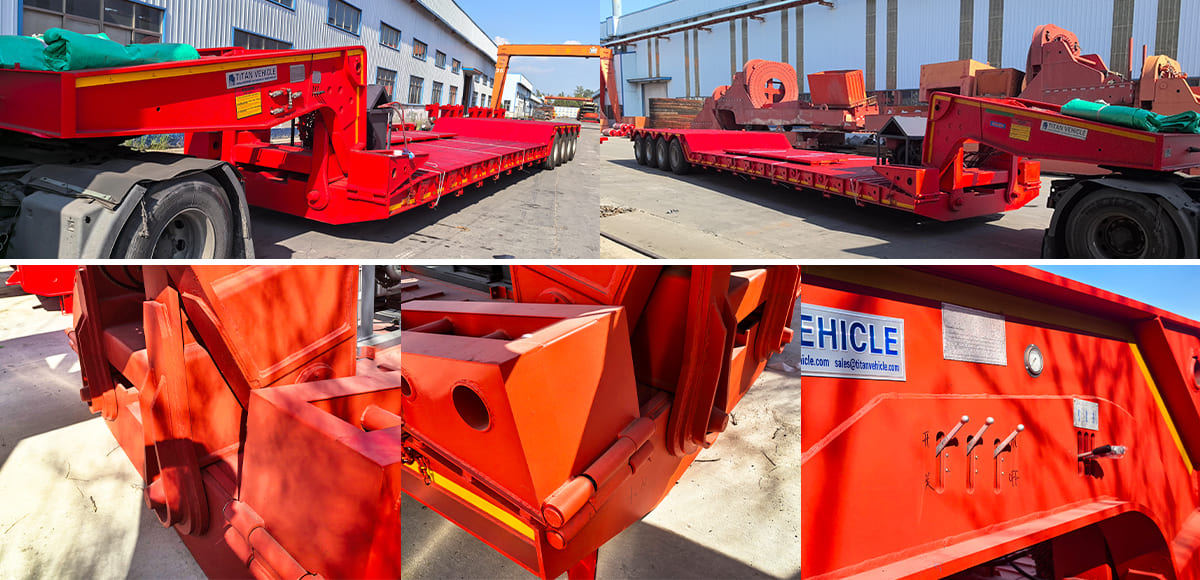 RGN Trailers | Detachable Gooseneck Lowboy Trailer for Sale in Ghana
The term RGN is often used as though it refers to one standardized trailer design. In reality, RGN trailers can differ in deck arrangements, loading configurations, axle layouts, and other technical details.
The detachable gooseneck is the defining concept, but it is not the only factor that affects how the trailer performs its role.The purpose is not to collect every possible specification. It is to understand which specifications directly affect the equipment being transported.
3.1 Deck arrangement affects machine positioning
The main deck is where the heavy equipment ultimately travels, so its usable arrangement matters.
The equipment needs enough deck area for its footprint, while the trailer must maintain the intended balance of the load. The relationship between machine position and trailer structure becomes especially important for equipment with concentrated weight at one end.
A longer deck may provide additional positioning flexibility, but what matters is whether that space corresponds to the machinery being transported. Likewise, a machine with a compact footprint may not require the same deck arrangement as a longer construction machine.
3.2 Axle configuration is connected to the load
Axles are another specification that should be interpreted rather than simply listed.
A heavy equipment trailer distributes the transported machine's weight through the deck, suspension, axles, wheels, and road contact points. As the equipment becomes heavier or its weight distribution becomes more concentrated, axle configuration becomes increasingly relevant.
Two trailers with different axle arrangements may be designed for different load requirements. What matters for the buyer is how the proposed axle configuration corresponds to the intended machine and transport application. This is particularly important when comparing quotations, because a difference in axle configuration can represent a genuine difference in the equipment being offered rather than a superficial model variation.
3.3 Loading geometry matters as much as carrying capacity
For an RGN, the loading path is central to usability. The gooseneck has to detach, the machine has to reach the deck, and the connection must then be restored for transportation. The physical geometry of that process determines how the machine interacts with the rgn trailers.
A specification sheet may describe length, width, axle arrangement, and capacity, but the real operational question is whether the machine can move through the loading path in the way the equipment is designed to support.
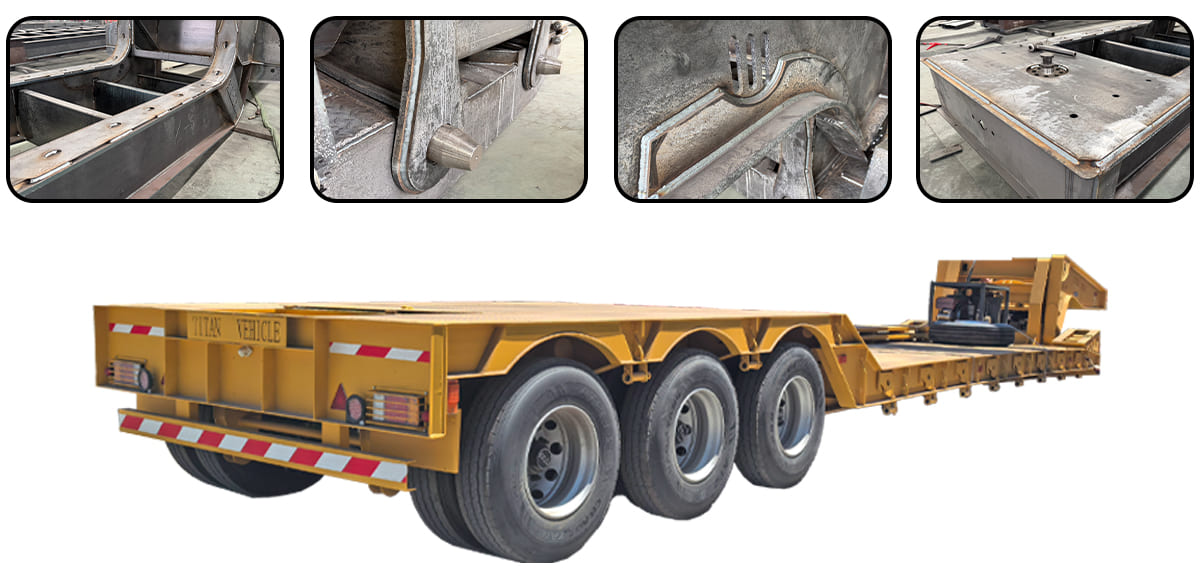
This is one reason pictures and technical drawings can be useful during an equipment discussion. They can help the buyer and manufacturer confirm how the machine sits relative to the deck, gooseneck, and other trailer sections.
| Item | 60 Ton | 80 Ton | 100 Ton |
|---|---|---|---|
| Axle Configuration | 3 Axles | 4 Axles | |
| Rated Capacity | 60 tons | 80 tons | 100 tons |
| Overall Dimensions | 14,600 × 3,000 × 2,000 mm | 15,800 × 3,000 × 2,000 mm | 16,300 × 3,000 × 2,000 mm |
| Main Beam Material | HG60 High-Strength Steel | ||
| Side Beam | 300 mm I-Beam | 320 mm I-Beam, 10/8/10 | |
| Deck Plate | 5 mm Checkered Plate | ||
| Axles | TITAN 13-ton × 3 | TITAN 16-ton × 3 | |
| Hydraulic Power | 12 kW diesel engine + hydraulic power unit | ||
| Hydraulic Cylinders | 4 | ||
3.4 Heavy equipment is not evenly shaped cargo
A machine such as an excavator or bulldozer does not distribute its mass like a rectangular cargo box.
It may have a heavy rear counterweight, tracked undercarriage, attachment system, engine compartment, elevated cab, or other components that affect where its mass is concentrated. That makes load distribution more relevant than simply looking at the machine's total weight.
A suitable detachable gooseneck lowboy trailer needs to be considered as a structural system receiving a particular load pattern. The buyer should therefore provide the actual machine information when discussing the required configuration rather than relying only on a generic equipment category. This is a more useful way to approach trailer selection because it connects the detachable gooseneck lowboy trailer to the physical cargo.
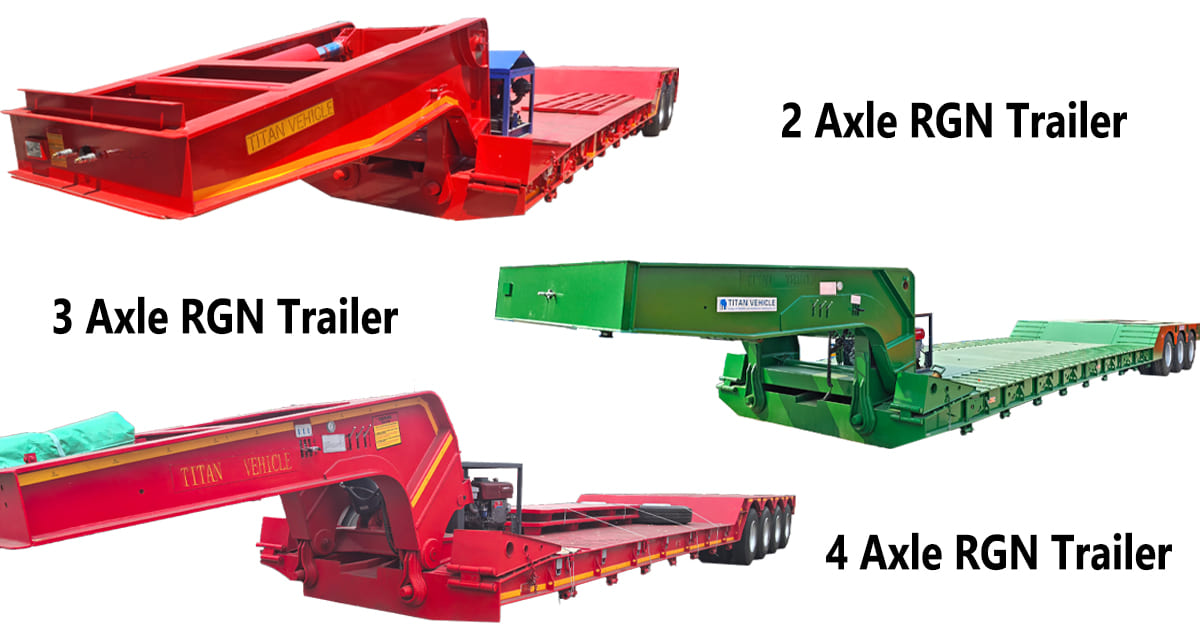 RGN Trailers | Detachable Gooseneck Lowboy Trailer for Sale in Ghana
For buyers in Ghana, the application of RGN trailers should be understood through the types of heavy equipment that need to move between working locations.
Construction projects, quarry operations, mining-related equipment work, earthmoving activities, and equipment rental operations can all involve machinery that cannot simply be driven over long road distances as part of its normal working process. The trailer becomes the link between those separate locations.
The important point is not that every project in Ghana requires an RGN. The requirement appears when the equipment, transport distance, machine geometry, and loading method make dedicated heavy-equipment transportation necessary.
4.1 Construction equipment transport
Construction machinery often moves as project requirements change.
Excavators, loaders, bulldozers, graders, and related equipment can be assigned to different work areas. Their transport requirements are therefore linked to project scheduling rather than to the movement of ordinary commercial cargo.
For these operations, a trailer's loading method can have a direct effect on how equipment is transferred from one location to another.
An RGN is especially relevant when the machine is self-propelled and needs to be loaded directly from the ground. The detachable gooseneck provides the transition between the working surface and the trailer deck.
For a Ghanaian contractor or fleet operator, the practical evaluation is therefore centered on the machinery being moved. The right trailer is the one whose configuration corresponds to the actual equipment rather than simply the one carrying the broadest product description.
4.2 Quarry and heavy-duty site applications
Quarry and aggregate-related operations can involve large mobile machinery that needs to be relocated as work areas change.
The equipment itself may be designed for severe working environments, but transport between sites is a different task. The machine needs to be converted from operating equipment into secured road cargo.
A gooseneck lowboy trailer addresses that transition through its detachable loading arrangement. The key issue is again machine compatibility. Equipment dimensions, weight distribution, undercarriage type, and loading approach determine whether a particular configuration is appropriate. The gooseneck lowboy trailer should therefore be viewed as part of the equipment logistics system rather than as a generic transport asset.
4.3 Mining-related equipment movement
Mining operations can require heavy machinery to be moved between equipment yards, support areas, and working locations.
The exact transport requirement depends on the equipment involved, but the same basic relationship applies: self-propelled machines need a reliable method of getting onto the rgn trailers and then being transported as road cargo.
The detachable gooseneck is not valuable simply because it is a specialized feature. It is valuable because it changes the loading method for heavy equipment. For procurement teams, this distinction helps keep the specification discussion focused on actual use rather than on a long list of features with no operational context.
4.4 Equipment rental and fleet utilization
A rental fleet can create another reason to use an RGN configuration.
Rental equipment frequently changes locations according to customer requirements. The trailer therefore supports equipment movement as part of the rental business rather than as a separate transport service.
In this environment, flexibility can become important because one trailer may need to handle several categories of equipment over time. That does not mean every RGN should be considered universally suitable. It means the trailer specification needs to be understood in relation to the range of machines the fleet actually handles.
A trailer that works well for one compact machine may not necessarily provide the same arrangement for a longer or heavier machine. For a Ghanaian fleet operator, the useful starting point is therefore the equipment list rather than the trailer model name.
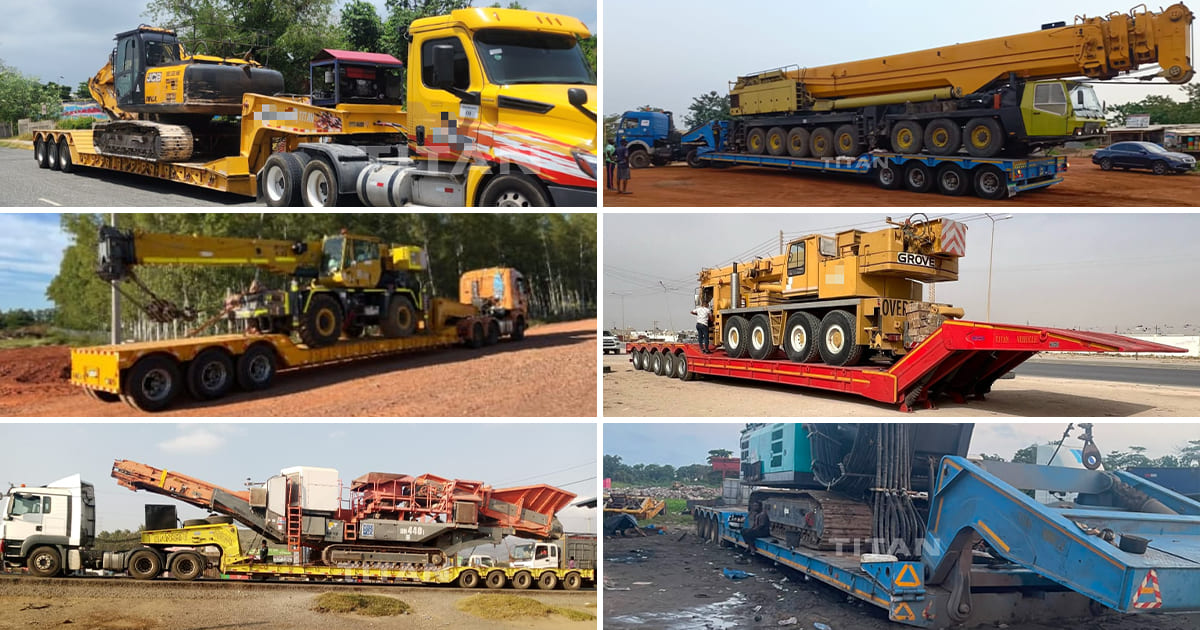 RGN Trailers | Detachable Gooseneck Lowboy Trailer for Sale in Ghana
An RGN trailer contains many technical details, but not all of them deserve equal attention.
The most useful evaluation is one that connects each important specification to the equipment being transported. This avoids turning a product comparison into a specification catalogue.
The core questions are straightforward: what machine is being moved, how does it load, how does it sit on the deck, how is its weight distributed, and what type of transport operation will the trailer support? Those questions provide the context for interpreting the specifications that follow.
5.1 Start with the machine
The machine determines the transport requirement. Its overall dimensions define the space it occupies. Its weight affects the required structural and axle configuration. Its mobility determines whether it can use the detachable loading arrangement naturally.
This is why a supplier should receive actual equipment information when preparing an RGN configuration. A general statement such as “heavy equipment” is useful for identifying the product category but not always enough to define the final trailer arrangement.
The closer the trailer configuration is tied to the actual machine, the more meaningful the technical discussion becomes.
5.2 Understand what changes a quotation
When two suppliers offer RGN trailers at different prices, the difference should be explained through actual configuration differences.
The relevant comparison may include the trailer arrangement, axle configuration, deck design, loading system, or other components that are actually part of the offered equipment.
A lower or higher quotation does not by itself explain whether the products are equivalent. This is particularly important for specialized equipment because apparently similar trailers can have materially different configurations. A quotation becomes easier to understand when the buyer knows which features are connected to the intended machine.
5.3 Avoid specifications without a decision behind them
A technical specification is useful when it answers a real question.
For example, the deck configuration matters because the machine has to fit on it. The loading arrangement matters because the machine needs a practical route onto the trailer. The axle configuration matters because the transported load needs to be supported and distributed appropriately.
Other details may still be important, but they should not dominate the discussion unless they directly affect the application.
This principle is particularly useful for buyers who are comparing imported heavy-haul equipment. It keeps attention on functional differences instead of allowing large specification lists to create the impression that every number has equal importance.
 RGN Trailers | Detachable Gooseneck Lowboy Trailer for Sale in Ghana
What is a detachable gooseneck lowboy trailer?
A detachable gooseneck lowboy trailer is a heavy equipment trailer with a front gooseneck that can be separated from the main trailer structure for loading. This allows suitable self-propelled equipment to approach the trailer at a low loading position before the gooseneck is reconnected for road transport.
What does RGN mean in heavy equipment transport?
RGN commonly refers to a removable or detachable gooseneck configuration. RGN trailers are designed around the idea that the front gooseneck can be detached to create a practical loading path for heavy machinery.
What is the difference between a gooseneck lowboy trailer and a standard lowbed?
The main difference is the detachable front connection and its effect on loading. A detachable gooseneck can allow self-propelled machinery to move onto the trailer from the ground, while a conventional lowbed may use a different loading arrangement.
What equipment can an RGN trailer transport?
RGN trailers are commonly associated with self-propelled heavy equipment such as excavators, bulldozers, graders, and wheel loaders. Actual suitability depends on the machine's dimensions, weight, weight distribution, and the specific trailer configuration.
Why is a low deck important for heavy equipment?
A low deck places the transported machine closer to the road surface, which can help control the overall height of the loaded vehicle. This is particularly relevant for machines that are already tall before they are loaded onto the trailer.
Are all RGN trailers configured the same way?
No. RGN describes the detachable gooseneck concept rather than one universal specification. Deck arrangements, axle configurations, loading geometry, and other technical details can vary according to the intended heavy-equipment application.
What should a Ghana buyer provide when discussing an RGN trailer?
The most useful information is the actual equipment that will be transported, including its relevant dimensions, weight, and whether it is tracked or wheeled. This gives the manufacturer enough application context to discuss a suitable detachable gooseneck lowboy trailer configuration rather than quoting a generic trailer.
Add: Nii Nortei Nyanchi St, Accra, Ghana
Marketing Manager: Hitomi Zhang
Mobile: 8615853176773


