
2: Flatbed Trailer Price in Ghana
3: Key Features and Design of Flatbed Trailer
4: Common Uses of Flatbed Trailer
5: What is the best flatbed trailer to buy?
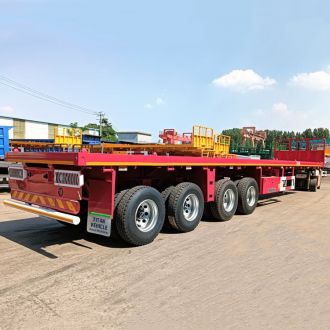
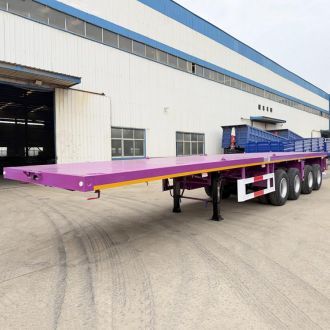
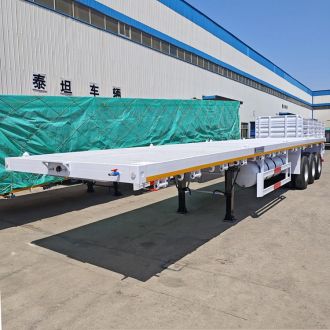
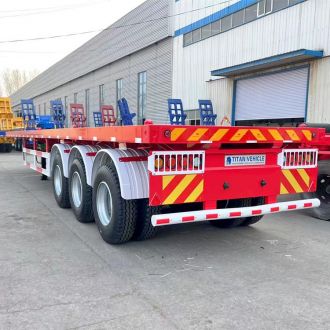
A flatbed trailer is a semi-trailer specifically designed for transporting shipping containers, primarily for road transport of standard 20 foot, 40 foot, and 45 foot containers. Flatbed trailer lacks a traditional cargo box structure, instead employing a flat steel platform. Containers are secured to the chassis using container twist locks, enabling safe and rapid transfer between ports, warehouses, and factories. Flatbed trailer is a crucial piece of equipment in modern container logistics transportation systems, widely used in port transport, international trade, logistics companies, and freight forwarding enterprises.
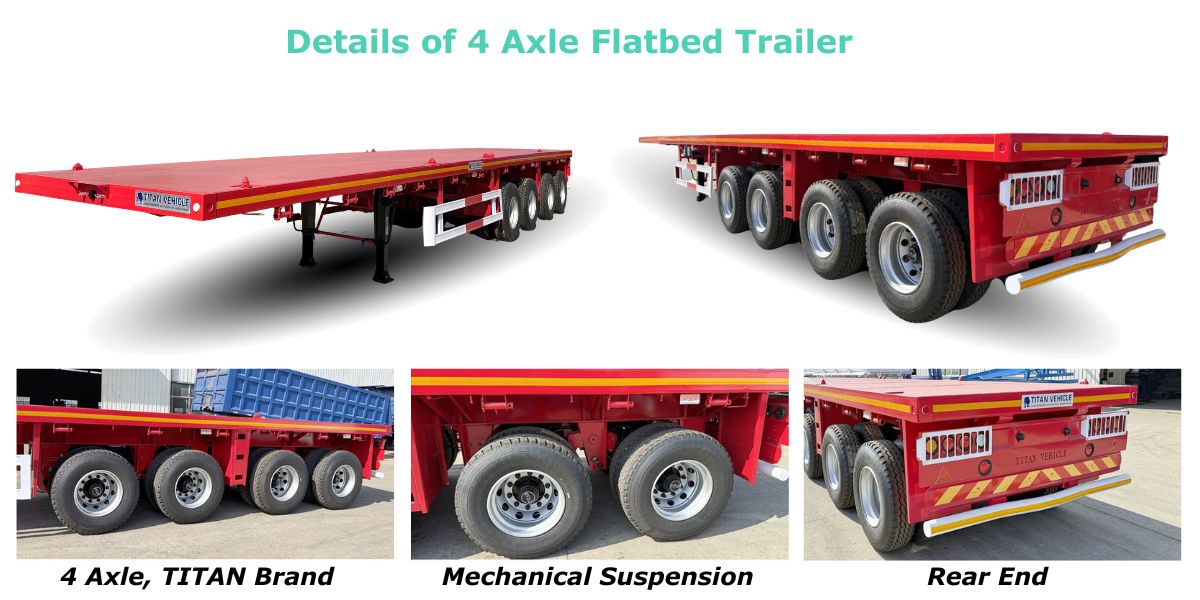
The main structure of a flatbed trailer includes the chassis, suspension system, axles, tires, outriggers, container locks, and braking system. The chassis, typically constructed of high strength steel, is the core load-bearing component, bearing the weight of the container and cargo. Depending on transportation needs, flatbed trailer can be designed with 2, 3, 4, or even more axles, and can be customized to comply with different national road regulations. For example, many African countries commonly use 3 axle 40 foot flatbed trailer, while some heavy duty transport markets opt for 4 axle or 5 axle structures to improve load-bearing capacity and road adaptability.
The biggest advantages of flatbed trailer are their high transport efficiency and ease of loading and unloading. Equipped with specialized container locks, flatbed trailer can directly secure the four corners of the container, enhancing transport security. Furthermore, their dimensions are designed according to standard container sizes, maximizing transport space and preventing cargo from exceeding the vehicle's dimensions and causing transport restrictions. Since containers can be quickly loaded and unloaded using cranes and forklifts, transport companies do not need to repackage goods; they simply hoist the container onto the flatbed trailer and lock it in place for transport.
Container flatbed trailers have different application characteristics in different countries. For instance, in the African market, due to the rapid development of port logistics, mining transport, and international trade, 40 foot container flatbed trailers are very common, often used to transport imported containers, mineral products, machinery, and building materials. In the Middle East, due to the developed port trade and logistics industry, many transport companies choose flatbed trailers with air suspension, single tire designs, or lightweight structures to improve transport efficiency. In Latin America, container shipping is also an important way to connect ports and inland cities, so there is a high demand for 3 axle flatbed trailer.
Depending on usage requirements, flatbed trailers can be further categorized into different types:
| Flatbed Trailer Type | Features | Applications |
|---|---|---|
| 20 Foot Flatbed Trailer | Designed with a shorter trailer body, offering better maneuverability and flexibility. | Mainly used for transporting 20ft containers, suitable for urban transportation and short-distance logistics. |
| 40 Foot Flatbed Trailer | The most widely used flatbed trailer type, with strong load capacity and high transportation efficiency. | Suitable for transporting one 40ft container or two 20ft containers, widely used in ports and international logistics. |
| Gooseneck Flatbed Trailer | Equipped with a gooseneck front structure, lowering the overall trailer height and improving driving stability. | Suitable for heavy container transportation and applications requiring lower center of gravity. |
| Skeleton Semi Trailer | Uses a lightweight frame structure, reducing trailer weight and improving fuel efficiency. | Specially designed for container transportation, commonly used in ports, terminals, and logistics operations. |
| Extendable Flatbed Trailer | Features an adjustable length design to adapt to different cargo sizes. | Suitable for transporting containers and oversized cargo with different length requirements. |
The flatbed trailer price of a typical 3 axle 40 foot model in the Ghanaian market is around US$9,500–11,000 (FOB China port price), while the flatbed trailer price in Ghana of a 4 axle, reinforced, or high load bearing version is usually around US$11,500–14,000. After the actual export to Ghana, the final landing cost needs to be calculated based on ocean freight, insurance, customs duties, and local customs clearance fees.
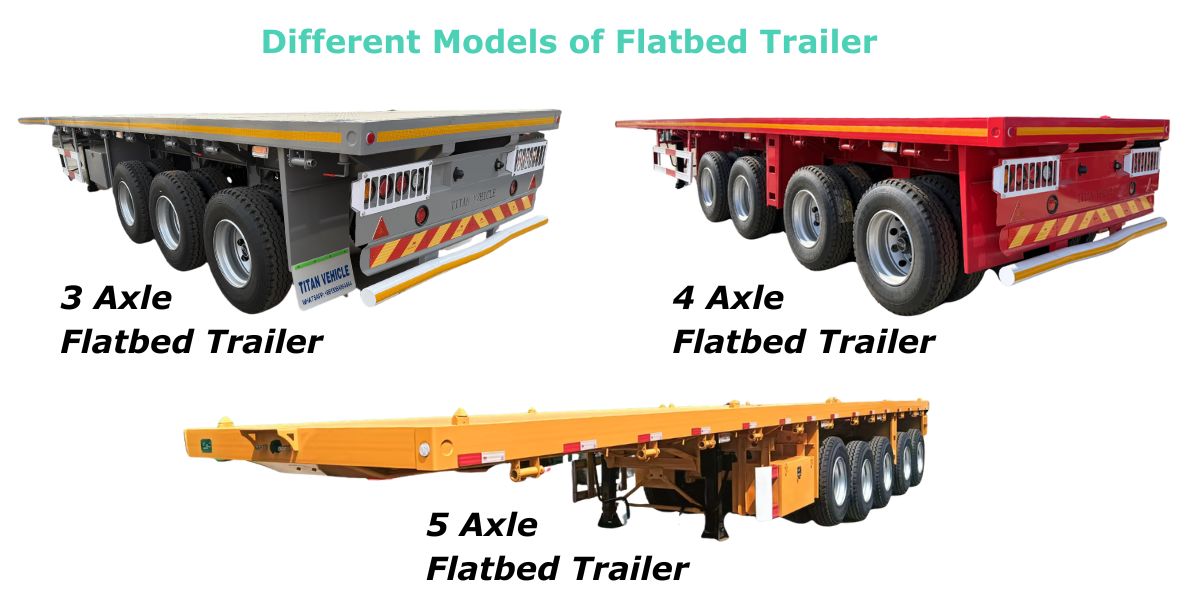
In the Ghanaian market, the 3 axle 40 foot container flatbed trailer is the most widely used type. It is typically about 12.5 meters long, equipped with three axles, and can transport one 40 foot container or two 20 foot containers. For Ghanaian logistics companies, port transportation companies, and freight contractors, this model strikes a good balance between transport capacity and purchase cost. A standard configuration 3 axle flatbed trailer price around US$9,500, while adding features such as reinforced main beams, wear-resistant tires, high quality suspension systems, and imported brake valves will further increase the price.
For customers requiring higher load capacity, 4 axle or 5 axle flatbed trailers are available. These flatbed trailers, compared to 3 axle models, have more axles, which can distribute the weight of the container and reduce the pressure on each axle, making them more suitable for some heavy duty transport operations in Ghana, such as mining equipment transport, steel transport, and heavy cargo container transport. The 4 axle 40 foot container flatbed trailer price typically ranges from $11,000 to $13,000, while 5 axle models, due to their more complex structure and greater load bearing capacity, may exceed $13,000.
The flatbed trailer price in Ghana is influenced by various factors, including vehicle size, number of axles, load capacity, configuration, brand, and transportation method. Generally, the mainstream model purchased by Ghanaian customers is the 3 axle 40 foot container flatbed trailer, as this type meets the needs of local port transportation, logistics distribution, and international container transshipment, offering good value for money.
The first important factor affecting the flatbed trailer price is the chassis structure. High quality flatbed trailers typically use high strength steel for the main beams, such as Q345B steel, and strengthen the design to improve the chassis's bending resistance and fatigue resistance. Road conditions in some parts of Ghana are not ideal, and vehicles often need to deal with potholes, long distance transport, and full-load operation; therefore, chassis strength is crucial to the flatbed trailer's lifespan. Although a reinforced chassis increases manufacturing costs, it can reduce later maintenance costs and improve the long-term operating profitability of the vehicle.
The second factor affecting flatbed trailer price is the component configuration. The axles, suspension, tires, outriggers, and braking system of a container flatbed trailer all affect the final price. For example, a standard mechanical suspension configuration is less expensive and suitable for general logistics transportation; choosing air suspension improves vehicle stability, reduces cargo impact, and is more suitable for high frequency transportation. High quality components such as JOST outriggers, WABCO brake valves, and branded tires will increase the flatbed trailer price, but they improve reliability and lifespan.
The third factor affecting flatbed trailer price is the type of container and customization requirements. Ghanaian customers typically transport 20 foot and 40 foot containers, so the vehicle needs to be equipped with a reasonable number of container locks. Some customers also request 20 foot + 40 foot universal lock slots, reinforced container locks, toolboxes, side guards, spare tire racks, etc. If customers have special transportation needs, such as transporting overweight containers or mining-related goods, additional frame thickness and load bearing design are required, all of which will affect the final quote.
In addition to the flatbed trailer itself, exporting to Ghana also requires consideration of ocean freight, insurance, port fees, and customs clearance costs. Chinese manufacturers typically provide FOB prices, meaning prices delivered to Chinese ports. Customers need to calculate the final shipping cost to Tema Port in Ghana based on real-time ocean freight rates. Since ocean freight costs fluctuate with seasons, shipping routes, and international trade conditions, the actual purchase budget needs to be confirmed based on the order timeline.
A flatbed trailer is a semi trailer transport vehicle specifically designed for transporting containers. It mainly consists of a frame, running gear, container locks, suspension system, outrigger system, braking system, and electrical system. Flatbed trailer structure is relatively simple, but each component directly affects the vehicle's load-bearing capacity, safety, and service life.
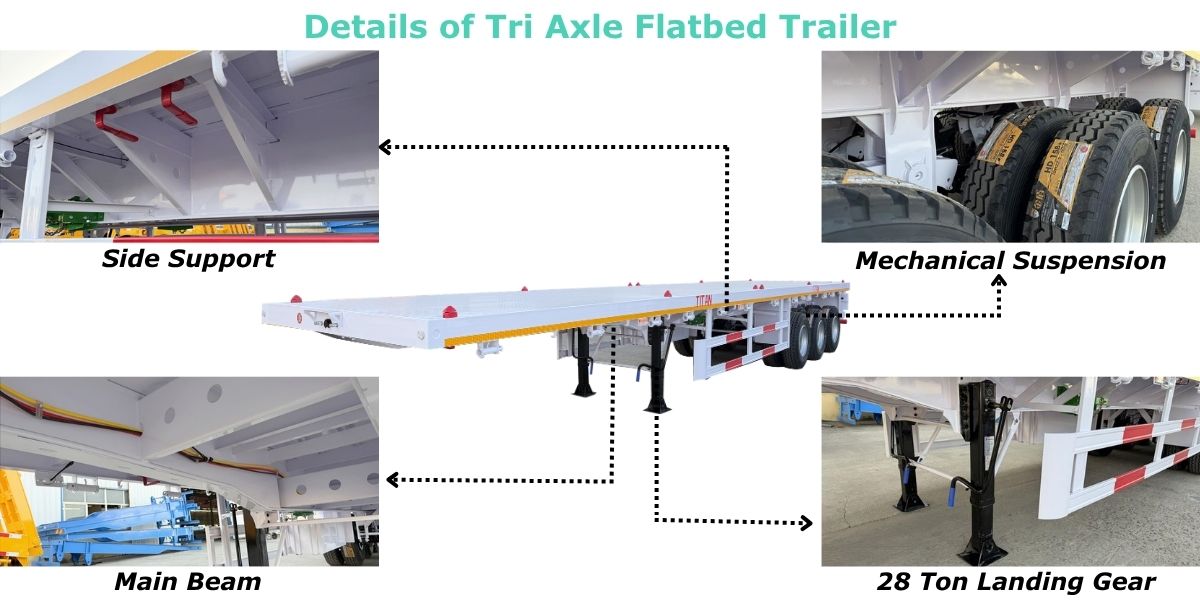
1. The chassis is the most crucial component of a flatbed trailer, serving as the foundation for the entire vehicle's load-bearing structure.
Flatbed trailer chassis are typically constructed from high strength steel and consist of main longitudinal beams, crossbeams, side beams, and connecting structures. The chassis must simultaneously withstand the weight of the container itself, the impact of road bumps, and the inertial forces generated during emergency braking, thus requiring extremely high steel strength and welding techniques. High quality flatbed trailers typically use high strength steel such as Q345B for key load bearing components, giving the chassis better resistance to bending and fatigue. During long term transportation, a robust chassis reduces deformation and cracks, extending the vehicle's lifespan. For markets that frequently transport 40 foot heavy containers, such as those in Africa, the Middle East, and parts of South America, a more reinforced chassis design can adapt to complex road conditions, improving transportation reliability.
2. Container locks are a key component of flatbed trailers.
Containers must be securely fixed to the chassis during transportation; otherwise, they are prone to shifting during high speed driving, turning, or sudden braking, affecting transportation safety. Therefore, flatbed trailers are equipped with specialized twist lock devices on their frames. These locks connect to the bottom corner fittings of the container by rotating the lock head, firmly securing the container to the flatbed trailer platform. Depending on the model, different numbers of locks can be configured; for example, a 20 foot container typically uses four corner locks, while a 40 foot container requires eight locking points at both the front and rear. Some high end models also use foldable and retractable locks, allowing the vehicle to flexibly transport containers of different sizes and increasing its applicability.
3. The axles and suspension system determine the load-bearing capacity and driving stability of the flatbed trailer.
Depending on the transport weight and regulatory requirements, flatbed trailers are typically available with two, three, four, or even more axles. Among them, the 3 axle 40 foot container flatbed trailer is one of the most widely used models globally because it achieves a good balance between load capacity, stability, and economy. For transporting heavier containers or in areas with poor road conditions, customers will choose four axle or five axle models, increasing the number of axles to reduce the stress on each axle and improve transport safety. Suspension systems are mainly divided into two types: mechanical suspension and air suspension. Mechanical suspension has a simple structure and is easy to maintain, making it very suitable for regions with complex road conditions, such as Africa. Air suspension provides better shock absorption, reducing the impact on containers and cargo during transportation.
4. The tire and wheel system bears most of the weight of the flatbed trailer and cargo.
Flatbed trailers typically use famous brand tires suitable for heavy duty transport. Different countries choose different tire configurations based on road conditions and operating costs. In Ghana market, due to complex road conditions, tend to use dual tire structures because dual tires offer better load bearing capacity and stability. Appropriate matching of tire size and axle load can improve vehicle safety and reduce long term operating costs.
5. The outrigger system, traction device, and braking system ensure safety when the vehicle is engaged and parked.
The flatbed trailer is equipped with a landing gear system at the front. When the flatbed trailer is separated from the tractor, the landing gear supports the weight of the cab, keeping the vehicle stable. High quality landing gear typically has a high load bearing capacity and can adapt to working environments with frequent loading and unloading. Meanwhile, the king pin connects the flatbed trailer and the tractor and is a crucial component that bears traction during vehicle movement. The braking system generally uses air brakes, including brake chambers, air tanks, relay valves, and ABS systems, which help maintain good braking performance under high speed transport and full load conditions.
6. The electrical system and auxiliary configurations improve the safety and convenience of daily vehicle use.
The flatbed trailer is equipped with a complete lighting system, including taillights, turn signals, side marker lights, and reflectors, ensuring safer transport at night or in inclement weather conditions. Furthermore, depending on different customer needs, the flatbed trailer in Ghana can be equipped with auxiliary equipment such as toolboxes, spare tire racks, side guardrails, and mudguards. For long haul transport companies, these configurations improve vehicle maintenance convenience and reduce downtime during transport.
The common uses of flatbed trailer in Ghana include: port container transshipment, import and export cargo transportation, domestic logistics distribution, cross border transportation in West Africa, mining engineering transportation, and commercial operations of logistics companies. With its simple structure, high transportation efficiency, and wide applicability, the 40 foot flatbed trailer has become a very important piece of transportation equipment in Ghana's logistics industry. For Ghanaian customers looking to develop port transportation and long haul logistics businesses, choosing a reliable flatbed trailer can effectively improve transportation capacity and reduce long term operating costs.
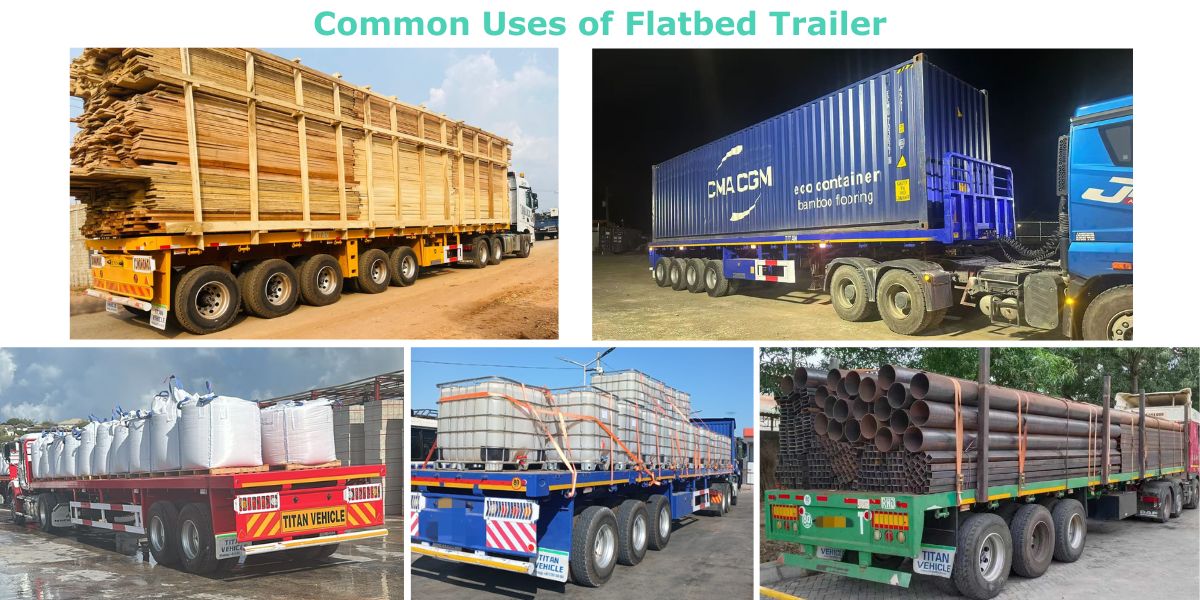
Ghana's Tema Port is a crucial container transport hub in West Africa, where a large number of seaborne containers are loaded and unloaded before being transported by road to various parts of Ghana. flatbed trailer in Ghana can quickly connect to port lifting equipment, transporting 20 foot and 40 foot containers from the terminal to logistics parks, warehouses, or customer factories, significantly improving cargo turnover efficiency. Flatbed trailer in Ghana use specialized twist locks to secure containers, ensuring container stability during long distance transport and reducing transportation risks.
As a major trading nation in West Africa, Ghana imports a large quantity of industrial products, building materials, machinery, electronic products, and consumer goods annually, while also exporting resource products such as gold, cocoa, and manganese ore. Flatbed trailer in Ghana can meet the standardized transport needs of these goods. Importing companies can use 40 foot flatbed trailers to transport imported containers from the port to warehouses; exporting companies can transport containers filled with goods back to the port to await loading for export. This mode of transportation is highly efficient and easy to manage, making it ideal for modern logistics systems.
Ghana needs not only port-to-city transport but also the transport of goods to the north and surrounding regions. For example, flatbed trailer in Ghana play a crucial role in transporting goods from Tema Port to cities like Accra, Kumasi, and Tamari. Because containers offer inherent protection, goods are less affected by weather during transport, making them particularly suitable for long-distance road transport. For logistics companies, a high quality 40 foot flatbed trailer can operate for extended periods, improving vehicle utilization and reducing transportation costs.
Ghanaian ports not only serve the domestic market but also handle the transshipment of goods to neighboring landlocked countries. For example, Tema Port's logistics network serves inland markets including Burkina Faso; therefore, flatbed trailer in Ghana is frequently used for cross-border freight. Transport companies can utilize 40 foot flatbed trailers to transport imported containers from Ghanaian ports to neighboring countries and then return to load export goods, achieving higher operational efficiency.
Ghana possesses abundant mineral resources such as gold and manganese, and also has numerous construction and infrastructure projects. Mining and engineering companies frequently need to transport mining equipment, spare parts, engineering materials, and large machinery components. Flatbed trailer in Ghana can transport not only ordinary containers but also special containers loaded with equipment, such as open-top containers and flat rack containers, meeting the logistical needs of mining areas and construction sites.
In Ghana, many transport companies, freight forwarders, and port service companies purchase flatbed trailer because this type of vehicle offers good economy and versatility. A standard 40 foot flatbed trailer can transport one 40 foot container or two 20 foot containers, adapting to different customer needs. Furthermore, flatbed trailer in Ghana simple structure and ease of maintenance make it ideal for commercial transport fleets requiring long-term operation.
Road conditions in some parts of Ghana are complex, requiring transport vehicles to have high reliability. Mechanically suspended flatbed trailer in Ghana has a simple structure and are easy to maintain, making them more suitable for local maintenance conditions. The reinforced frame and multi axle design improve load bearing capacity and reduce wear and tear during long distance transport. For the Ghanaian market, the 40 foot flatbed trailer is typically the most popular configuration because it strikes a good balance between load capacity, stability, and price.
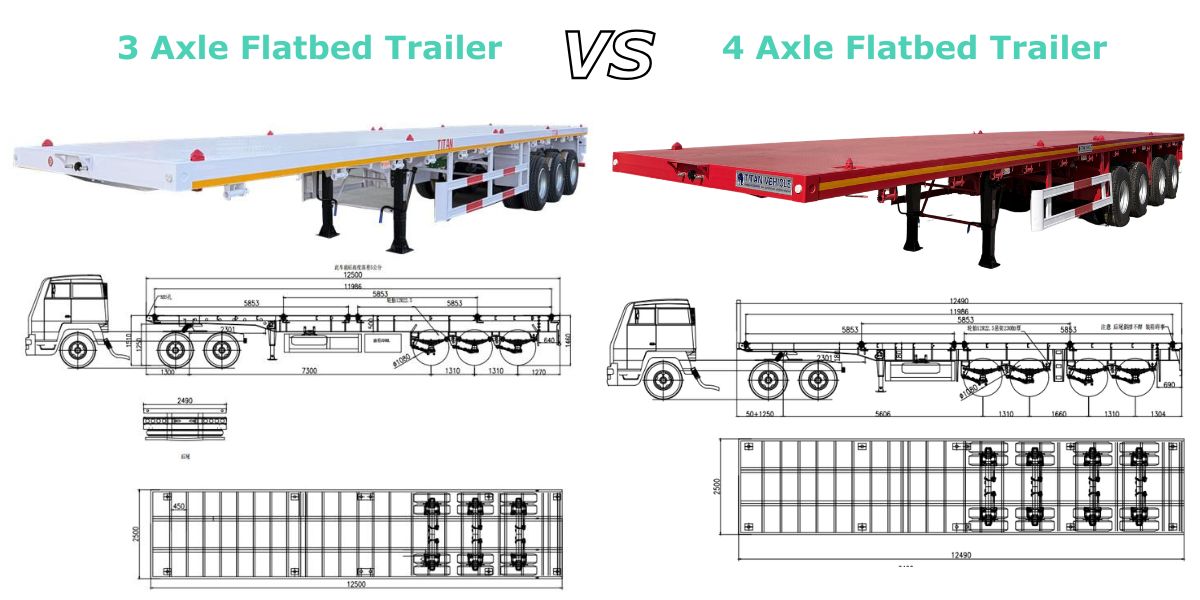
For the Ghanaian market, the most suitable flatbed trailer is typically a 4 axle 40 foot container flatbed trailer. This type of flatbed trailer achieves a good balance between load capacity, road adaptability, transport efficiency, and purchase cost, making it ideal for Ghanaian port transportation, logistics company operations, and long-distance freight needs.
The first reason the 4 axle 40 foot flatbed trailer is best suited for Ghana is its wide range of transport capabilities and strong versatility. With proper arrangement of container locks, it can simultaneously accommodate the transport needs of one 40 foot container or two 20 foot containers. One flatbed trailer can cover a wider range of customers, serving not only port container transport but also handling transport orders from factories, warehouses, and trading companies, thus improving vehicle utilization.
The reinforced chassis design is more suitable for long term heavy load transport. Container transport in Ghana typically involves long-distance trips, such as from Tema Port to Accra, Kumasi, and other regions. Long term fully loaded transport requires semi-trailers with high chassis strength. 4 axle flatbed trailer suitable for the Ghanaian market typically employ high strength steel in their main beams and reinforce key load-bearing areas, enabling the flatbed trailer to withstand the impact and torsional loads of long-term transportation and extending their service life.
A 4 axle configuration can meet most of Ghana's transportation weight requirements. Unlike some developed countries with well developed highway transportation systems, many transport routes in Ghana traverse roads of varying grades, thus requiring vehicles to strike a balance between load bearing capacity and flexibility. The 4 axle flatbed trailer design effectively distributes the weight of the container, reduces the stress on each axle, and improves driving stability. The mechanical suspension structure is simple, the leaf springs have high load bearing capacity, and local maintenance resources are readily available, resulting in lower long term operating costs.
For the Ghana market, the most popular and recommended model is the 3/4/5 axle 40ft flatbed trailer. It is suitable for container transportation, port logistics, and long-distance cargo transportation.
TITAN flatbed trailer usually has a loading capacity of around 60 tons, depending on the frame design, axle type, suspension system, and local transportation regulations.
Flatbed trailer in Ghana can be equipped with reliable axle systems according to customer requirements.
Common choices include:
The axle selection depends on cargo weight, road conditions, and transportation regulations.
TITAN flatbed trailers are widely used in Ghana for different transportation needs, including:
A high-quality container flatbed trailer can normally work for many years with proper maintenance.
The service life mainly depends on:
TITAN flatbed trailers can be customized according to Ghana customers’ requirements, including:
This allows customers to choose the most suitable trailer according to their transportation business.
Add: Nii Nortei Nyanchi St, Accra, Ghana
Marketing Manager: Hitomi Zhang
Mobile: 8615853176773


